Sunday, December 31, 2006

Happy new year!

Happy new year to all. The new year is starting off again with new promises, new resolutions, new business, new projects. I wish everybody well in the coming year and hope that they will get closer to the realization of their dreams.

There are some interesting developments on my own projects. Project Dune has launched a community site: http://pdune.sourceforge.net/ and I am waiting anxiously for people to start using it. The project has been rising in the popularity ranks at SourceForge and it's quite difficult to maintain momentum at these positions.

The good news is that I will be releasing a Beta release pretty soon. There is more working functionality, the main problems have been dealt with and so I am happy to upgrade the status at this time.

It probably won't answer immediately to your needs in your project, because the rules for ownership transfer and updating are rather generic and default. I'll only be able to make some good improvements when I learn more about how people want to use the software.

See you in the next year! I'm off to the beach to celebrate and will be back tomorrow....

G>

Tuesday, December 26, 2006

Measurement

I have read a book titled "Measuring and Managing performance in organizations". It really is an enlightener.

As many know, I am working on a project called "Project Dune" on SourceForge, which is related to quality. You could say that quality is highly dependent on measurement. And for measurement, you need to generate data and do that in such a way that you can historically compare one data-set with another. The end result is hopefully some insight in how you are doing as a team/department/organization.

Well, it is not really that easy. When you start to measure in an organization, you need to generate the data and both activities are coming at a cost of that same organization. Effort removed from normal production work. Well, obviously it is required to find a balance between going for production and generate the data anyway since you need to find a way forward to improve and without information backing up any decisions, you base all decisions on intuition, which in general can be very deceiving.

Project Dune is interesting in that the vision is that it should do the measuring for you. It is basically a similar tool like BugZilla, Mantis and so forth, but in addition to helping with standard administration and tracking, it also helps in day-to-day activities. And that is where the automation is plugged in, next to its envisioned integration points.

When you start to connect a system that knows about user activities, it can connect the data for its users and the larger the domain is where it is connecting "dots", the larger is the area that you can measure across.

The good thing about this is:
  • You get the measurements almost for free, always up-to-date and in real-time
  • You are better supported in day-to-day activities
  • You can spend more effort on your productive tasks without worrying about any process or dependent tasks that you do for others
Of course, it is not really that near to completion, but a BETA is coming out not too far from now. I'm just thinking about server-side call control (security) before I can even call it BETA. So far I have no feedback yet, but hope to see that happening at some time soon.

The statistics for the project are ranking up at the moment. The project is available at the third page in the rankings at this time (103) and seems to be going up still. A new ALPHA-3 release was just issued today. Let's see what happens next :)

Regards,

G>

Friday, December 15, 2006

Progress on Project Dune

I am progressing very quickly recently on the Dune opensource project.

It is a quality automation system. The objective is to make it work similar to BugZilla or Mantis in the sense that it maintains issues, but it also maintains information on:
  • tasks
  • customers
  • projects
  • functional requirement items
  • use cases
  • test cases
  • subversion commits
This way, the project is able to report across the whole area of development eventually. This also opens up the path to automation in traceability and probably therefore control.

I'm thinking of writing a theoretical paper on the subject of quality automation and the information that is supposedly lacking in quality plans, even though data is being "gathered".

check out the Project at Source Forge

Tuesday, December 12, 2006

Quality in Innovation

This post is my personal opinion and does not reflect the opinion of my employer... yadda, yadda...

I'm reading several books at the moment, one of which is the book to CMMi. This is basically deriving a vision for continuous process improvement in a company. But there are things seriously wrong with CMM. It is geared towards establishing a "static" state atmosphere, because if this were different, it would be very difficult to apply measurements across the process. A dynamic setting like an innovative powerhouse has severe problems adopting more rigid procedures due to the nature of their work. It is *not* a factory and they work with people that are intelligent and know what they are doing. Why insult them with procedures that tell them what to do, if they are the ones that know best?

The final level of the CMMi Zen approach is: "the optimizing level" :). I compare this to an engine room of a ship (I used to work in shipping).

This is where every process is defined and measured, you have all the spare parts you need, you have all the supplies you need and the ship hums along without a glitch. No leaking oil, no weird sounds, there are no bearings about to break or go. The chief engineer only walks around to tweak some settings on regulators for the form of it, puts his ear against a machine to hear its performance. It might tell the 2nd to replace a filter here or there or schedule an overhaul in the future, but overall the performance is so magnificent that everybody can go upstairs to the ship's bar. That's Zen, but software is pretty much different, especially when working on innovative and new products. Technology moves a *lot* faster in IT than it does in shipping. The speed at which new technology can be consumed on the ship is because they are users of that technology, not creators. And in software you may find yourself working on an embedded system to monitor cars first, subsequently followed by the latest technology in Ajax to create a project management system.

The later parts of my 729-page CMMi guide talks about "statistics" and "statistically managed subprocesses". Surely it must be evident that if you are not continuously repeating what you are doing, you are not building any historical data and thereby not creating the data necessary to improve your processes.

The real reason why it is so difficult to integrate with these quality visions is because in IT we are learning new things every day or encountering problems that are not standard. If I was working on a project with really new technology or bending the rules of what is possible with that technology, I would deserve a couple of days extra to find out ways and alternatives. I might choose a wrong alternative first and then have to rework. I might have to read through books of protocols in order to even start with architecture or coding. I may have people in the team that need to be trained.

Is a quality process that relies on repeatedness able to improve the quality of what I am doing?

....

I am not convinced!

( also check out http://www.joelonsoftware.com/articles/Craftsmanship.html )

Thursday, December 07, 2006

Software Quality

This is one of the first posts on software quality. Since 2002 I have been working on a project called "Dune", which is basically an automated system that helps you in the process of quality (it does not inspect, nor write code for you, nor writes documents), but if your company has strict processes regarding baselines, inspections, document control and especially traceability, this may be an interesting thing for you to try out.

The software is at: http://pdune.sourceforge.net and http://www.sf.net/projects/pdune.
Yep, it is GPL'd, so anybody can download, help out and use it, however you cannot take the sources and close it down for any commercial product.

There are some good rationales behind the project that I am going to write and design soon and put on the site. The whole work on the project is good to understand quality a lot better. I read through entire books about software quality (dry reading material about "process", "audit" etc. *yawn*), but in the end just discover that whatever they are talking about.... it can be automated! And how many tools do you know that automate traceability and have import functions for project plans, RF and UC documents?

A "quality process" in the end is nothing but the definition of responsibility. Setting the boundaries where the responsibility of one person ends and the other starts. So if you believe that a process is going to improve your software, I wouldn't really think so. The only thing able to do that are the people that you have in your time. The process should only help to create an environment wherein this team can flourish! And as written before, definition of processes is not always good, because if the process writer 'forgets' to write down a certain responsibility, it is likely that this issue falls through the cracks with no one to blame (blame it on the process, not yourself :).

The rationale for adopting a software quality standard doesn't really have much to do with actual software quality. That is, a software standard certification need not be in place in order to write good software. Good quality depends on good people, not on processes of any kind. It may help, but only if the process is defined and adopted by the people in the company. Rather, a process must be seen as the formalization of how work is done in that company with that culture, not an enforced method of work by a select few in the organization that read a good amount of books on software quality and then run around crazy with the theory.

I have not yet read CMMi in its entirety, but I understand what it is about. I am not yet sure whether what I am building will comply with CMMi or vice-versa. I do expect though that the "rules for certification" of CMMi fit in nicely.

Any quality "system", whether this is a quality plan, a set of software tools or adopted method of work should aim for a couple of objectives to achieve software quality:
  • transparency
  • traceability
  • control
Control is the means that a team has to exercise control over the 'states' in the project. There are initiatives, purchases, work items, bugs, features and change requests to be managed. The better the software is aligned with how the team wants to manage this information, the more effective it will be.

Traceability has much to do with the CMMi and ISO standards. This is often interpreted as a "paper trail", but I argue that it might just as well be a set of records in a database (it is actually much better). Traceability has much to do with "auditing" as well. To know when, how and who is basically the question that for each initiative, bug and feature needs to be answered.

Transparency means a system where the information is close to the surface. One should not have to open a separate locker with a key that only the manager has to go through drawers of paperwork to find out what happened to bug #35. This is one extreme transparency problem, but it shows how transparency is important in a system. Transparency is basically a measure how easy it is to get to the information in the system. The easier it is, the more value the system generates for its users.

So, this is what I am building. An automated quality support system. The system by itself is incapable of guaranteeing quality, but it helps to lift the effort in maintaining the audit chain and ties control, transparency and traceability together. This is very important for people involved in software development. It relieves the people involved from a couple of hours of effort a week (as an estimate), which can be directed to something really productive.

Tuesday, November 28, 2006

Measuring Performance

Here is a very interesting link to measuring performance and its results:

http://www.joelonsoftware.com/news/20020715.html
It is already common knowledge that whatever metrics (goals) you put in place, people will work towards maximizing that particular goal. Having several goals initially creates a lot of confusion and discussion about the weight of each, but eventually this settles and creates a certain "culture", which you could consider as a weighting of the objectives of that group of people.

A proper means of measurement has everything to do with renumeration models:

A renumeration model for distributed development

Setting a single and individual goal for productivity will fail. People will refuse to work together, there is absolutely no cohesion in the team, only competition. Beyond this not being a 'fun' place to work, it is very stressful and breeds backstabbers. So we need a complementary force to pull the team together. Some competition is good (as it 'advances', but it cannot outperform the need to collaborate).

( There is also some more information on Joel's blog about incentives. )

In the future I believe that the "an-hour-a-dollar" system of renumeration will eventually wane away. Simple because more people will (want to) work at home, collaboration becomes possible with enormous installations of fibre around the world and there is no sense creating a huge, expensive office infrastructure when you spend only a fraction of that cost to develop one's home office.

Fiber installation in Iceland
The traditional hour-measurement systems, if installed at home, can easily be circumvented and cheated. So there is a need for a set of personal and group objectives with appropriate weights, tied together in a renumeration system. Maybe group objectives are better explained as "individual penalties".

You need to reward people that pull the team forward (individual objective), but you cannot reward people that leave the worst work to others (group objective). You cannot penalize a group when one worker leaves much to be desired (group objective), but you cannot penalize newcomers straight from university from not performing too well (individual objective).

In my previous post I discussed the possibility to tie company profit into this system of renumeration (making company profit have an effect on 'salary')

The reasons?

"Having a job" is the most wonderful thing in the world. There is no stress involved if you compare this to actually owning a company. Maybe the knowledge workers of today, consistently aiming at more benefits should feel obliged to share at least some of the burden of finding a proper path for your company to grow. Either through a negative incentive or through a positive renumeration?

The other thing is that it puts more pressures on companies to leave work behind that is simply not productive. You'll be amazed how much is still being done nowadays that does not contribute to a final product. In theory, such a tie with profit would make the company much more flexible and the human capital organizes itself better. But I guess only when it decreases salary. There are some schemes for profit sharing, but this is on top of the guaranteed salary, so the incentive to aim for it is much lower.

Monday, November 27, 2006

Smart homes in Korea

This article talks about smart homes in Korea:

http://news.bbc.co.uk/2/hi/programmes/click_online/6179868.stm
I did a project on home automation some time ago and we're just scratching the surface. There are quite some people out there who see HA as a hobby, but the market is starting to get itself organized on better features.

As soon as the more mature electronics producers will start to develop and market some better gadgets and there are standards for ex-change of data, this may actually set off on a very fast pace.

In the vision of HA, you need to see the house as an extension of yourself. It does not only "manage itself", it also manages things around you and all of the house's inhabitants. As soon as the house is empty, it turns itself off :).

The computer that you are now in front of can actually become an integral part of your house. There is not necessarily a need for this computer to stand in one place. Why not move around, do your stuff and still interact with anyone you are talking no matter the room you are in?

The advances and implementations of social networking show how we are picking back up the ways of interaction and finally start to expect our machines to serve us, instead of being slaves to the keyboard or "program implementation" (that's just the way it works, now learn it!)

Korea's smart home shows it is not just about ambience, it is also about providing feedback on certain stuff like washing clothes... Being "smarter" than the inhabitants and giving them tips before the bad things happen.

Is the actual step in HA a house that takes care of its inhabitants? Can the electronic house of the future act as a digital baby-sitter?

Sunday, November 26, 2006

Royalties....

100. Musical instrument shops must pay an annual royalty to cover shoppers who perform a recognisable riff before they buy, thereby making a "public performance".

http://news.bbc.co.uk/2/hi/uk_news/magazine/4566526.stm

Monday, November 20, 2006

Australian copyright legislation rushes on!

A post about copyright law in Australia this time. Australia is seeing new legislation rushing through Parliament that would incriminate many regular Australians now and in the future by copyright violation.

New Copyright Laws Risk Criminalising Everyday Australians

Happy Birthday Song
It's very silly, but even scarier. At the moment, luckily enough, everybody I talked to finds this appauling and very silly. But what if this trend continues? Then you won't be able to whistle or sing anything from the radio in the street anymore since that counts as singing. The band next-door won't be able to perform in the bar two blocks away unless they pay royalties...

The danger of individual freedom and liberty is obvious. But what of the homogenisation this may inflict on our culture:

Consider a futuristic scenario where a very large computer will analyze written pieces of music with pattern-matching algorithms to see how much of the song is based on other songs and spews out a number which is what the person should pay in royalties?

If a system exists where we have perfect control over who listens to what and how this is distributed, then we will only be able to hear some new piece of music when you pay for it. Consider the bad implications. The radio stations and TV are the only means that you can hear something new, which most likely leads to massive homogenisation of the music industry. It is no longer the consumer who controls what is cool, but the production companies (maybe this is already commercially determined in this way at the moment, but not yet technically enforceable).

As a human being there are only x hours in the day / month that you can be provided entertainment. This means we continuously make changes on what to hear or see. If there would be zero piracy, the divulgence of unknown bands is very low (since there is a cost associated with its purchase and people in general don't like buying something that is not known what it is beforehand).

A little bit of piracy is just plain healthy, especially for culture. Music and films are not "material goods" where it can be directly associated with a cost. It's a lot more or less than that.

Check out the process for making a film:

Peter Jackson will not be involved in "The Hobbit"

Time for a new business model!

Monday, November 13, 2006

Telecom Billing Systems

I am reading on the main book that is refreshing my knowledge on billing systems. This book was bought on Amazon and some guy has written in quite good terms and vocabulary what a billing system really is all about without all the technical fuzz and buzz.

It is describing customer management, provisioning from other systems, the billing interfaces towards finance and fraud detection, the focus on the account as a billable entity, reconciliation, usage calculation, product charge calculation and so forth.

Well, it is going to take me some time to finish up, after which I have another book ready that is overdue (The World Is Flat) and another book that I have read from A - Z but have not sunk too much into the exercises which is an introduction to accounting.

Another thing I am doing at the moment is setting up a new experimental site that shows a menu for open source projects. Not sure where this leads at this point, could be anywhere, but it is a nice initiative to finish. That's right, I sort of started by mentioning it to someone but never got to the point of actually starting due to a lack of web server space, but I remembered that Google offered pages as well.

It's at http://gtoonstra.googlepages.com.

Sunday, November 12, 2006

Human (Parallel) Processing Power

I was surprised recently about the power of parallel processing when many people focus on the same objective. Some person had the cellphone lost or stolen and some hours later her Flickr account showed a photo taken with the cellphone of two rather ugly individuals. The background showed only part of a wall, a window, a reflection and part of a lantern and a wire.

She posted this picture on some well-read forum and within minutes the readers resolved the actual location and resolved other questions about the identity of the individuals in the picture.

This shows me that certain small tasks with a desired result (identification, problem resolution, etc.) can become very easy as long as you have a large enough audience to process it. There was a large amount of noise generated by this audience, but inbetween some very interesting resolutions and suggestions.

There are probably certain limitations on the efficiency of such an effort:
  1. The end result must be clear and objective. This rules out open questions. (how to....) is not a good question to put in a processing task.
  2. It must be a small enough task that only requires knowledge and creativity to solve. Actual manual effort would be very difficult to organize and coordinate.
  3. It must be a problem that lies within the expertise and experience of the audience.
  4. The community should be able to share references to documented knowledge or images.
Considering what this means for a larger company... If you have say 600 employees and all 600 of them put their brains to work for five minutes on a single question that has a clear objective, then you get the collective experiences, expertise and insight of all those 600 people plus an aggregate of 50 hours of worktime at relatively no cost at all, since 5 minutes loss of work is not very significant in a day. If the problem is relatively within the expertise area of this audience, the resolution path might put you right on course for a perfect resolution.

I can imagine that for the single person to develop a good resolution path to this problem it would take much longer than 50 hours and it might not be optimal. There is also no knowledge sharing (since the result is published otherwise).

Is it better if the result is developed and shared automatically by all people involved? Can the audience that is participating steer itself in the best direction for the resolution and auto-correct eventual mistakes?

I found some interesting sites on this topic that also touch on something else, human-computer interfacing on the brain-level:

Yasir's Blog
Integrating computers with human brains
Riya
Now, on another note, already scientists have developed software and hardware that allows a paraplegic to move a cursor on a screen. There are two things to consider here. With bionics we can augment human functions and allow the human to improve, but vice-versa we can also create human interfaces that would complement a computer so that some automated process becomes much easier.

In a way, Flickr is something like this. It receives keywords from people browsing the photo's, so-called tags and then indexes photo's accordingly. The classification of things thus happens with people whereas the rest is simpler to automate by machines.

Maybe we should run some experiments by thinking of some not too difficult objectives to achieve and see how we perform in the resolution of that problem.

G>

Tuesday, November 07, 2006

Flourishing in the private sector

I'm reading up in a book from "C.K. Prahalad", The Fortune at the Bottom of the Pyramid. This book is mostly looking at a portion of society that is not totally impoverished (extreme poverty), but certain means at its disposal to make purchasing choices and maybe even has the capacity to save (capacity being not the same as possibility). Well, if it was meant to address the totally impoverished, see previous post that explains how I disagree :).

The questions that are being raised now for Brazil are:
  1. Does India / China relatively have many more startups than Brazil?
  2. Is the global and international activity (objective) of those developing countries more aggressive than the Brazilian activity?
  3. Are the legal systems for China and India better developed (maybe in definition of law, otherwise in its enforcement) than Brazil?
  4. What are other important factors to take into consideration when considering stagnant economic activity?
I'm making assumptions here that the production capacity of Brazil is much higher than current production. The book of Prahalad has a chapter on corruption that is for me a very interesting read that goes further than just eliminating corruption, it also offers solutions. Part of it is digitizing the local or state government and reversing the role of government by not making citizens comply with the government rules (which has never been seen as the objective of government), but to make the government adjust to the wishes of the citizens.

This concept is also known as e-governance. The introduction of this will surely produce an initial surge in corruption and malfunction, but later on it should produce a better balance of power and consistent treatment and application of law, if we assume the knowledge of the general citizen sufficient to be part of this system (that is, part of its reasoning must be based on individual interest, but a grand part in the interest of a group, which is society).

India is doing this in one state already, the state of Andhra Pradesh. Here the political leadership wanted to turn around the excessive burden of corruption especially in the registration of land. They invented a computerized system that makes it much harder for corruption to manifest itself. The result was that the public no longer needs to pay the corruption fees and therefore also change their perception about the level of corruption in government.

Since then, the state has sought to automate and digitize many more public services. In this way, the citizen also becomes an agent in the system and it's more of a "self-help" way to interact with government. Government, after all, is a representative of the people and serves to administer the access to public services by those people. It has power to make laws, execute laws and judge people that break the social contract with the government.

One side of politics argues that a country that lacks an effective justice system has little chance to increment economic growth because there is lack of confidence in people that property rights are maintained. This reasoning goes all the way back to Hernando de Soto. (the other political side mainly talks about social injustice and social inequality, causing problems to generate more wealth in the long run).

I tend to believe that when contracts cannot reasonably expected to be enforced, it becomes difficult for new entrepreneurs to engage in business because the non-compliance is seen as a threat. The current legal system in Brazil seems to reflect this. Too many people and legal professionals I met are faced with 4-5 years to solve a particular case. Only when this can be expedited or alternative measures for contract enforcement are found will we probably see some higher growth rates. (China, for example, has enormous corruption and a poor legal system, but the contracts are enforced between the business people themselves, more by honour than by a legal framework that backs them up).

Final word about e-Governance... not only is corruption reduced but in the example of the Indian state... The workers there were required to stand in line 4.5 hours per month to pay their electricity bill. Prahalad estimated this to be U.S. $45 million in one city per year. So, by improving the access to information and access to public services by automating and digitizing those, we can reduce the level of spending (less gov't employees and wages) and the workers do not have to spend 4.5 hours per month standing inline and continue to work.

That sounds like a win-win situation...

Monday, November 06, 2006

The End Of Poverty?


I've just finished the last bits of this book "The end of Poverty" from Jeffrey Sachs. It is an amazing read and it shows the hands-on experience of this professor, now Director of the Earth Institute.

The book explains how poorly understood the concept of poverty really is and even sometimes how much poorer are the understandings of the solutions to counter it. It talks mostly about government interventions as a necessary solution to combat extreme poverty, which is defined by the World Bank as those people living at less than US$1.08 per day (Purchasing Power Parity-adjusted).

I found a couple of arguments and statements very intriguing in this book. Also I had a look on wikipedia which I consider a source of general public opinion to compare the views of the book with what "the world believes".

If you read the text from the link: Wikipedia Cycle of Poverty then you will notice that there is a lot of mumble about education, privatization and so-called "free-market solutions". The IMF and World Bank are not just subscribing policies to poor countries on what to do with these elements to alleviate poverty, but also maintain in many cases a political agenda.

As the book argues, the "extreme poverty" question has not much to do either with education, privatization, nor so much government corruption. It is on a lower, more basic level than that which is that the people do not find the ability in their country to save and therefore invest into a better future. This happens in Africa mostly due to a number of issues:
  • 90% of malaria deaths occur in Africa (which can be treated, but the African mosquito really likes to bite humans rather than cattle, plus it is warmer, which intensifies the impact of malaria 3-4 fold).
  • AIDS literally rages through Africa in Sub-saharan countries.
  • The grounds on which they attempt to grow their crops are totally depleted of nutrients.
  • Lack of infrastructure
  • External trade-barriers
For some more background on the above, check out Wikipedia again: Poverty diseases, Global Distribution of Poverty, Child Malnutrition (measure for hunger)

There is actually an interview with Mr. Sachs about his book over here. It explains better the reasoning that the book is trying to make clear.

Many people naturally assume that poverty is 100% about corrupt governments, an idea that if governments and public institutions work perfectly, wealth generation happens naturally and economic growth results. The book has shown me that this is not necessarily the case.

In some communities in Africa, the people need all the food they grow for themselves, so lack any savings / investment basis to allow them to grow further. Plus that the impact of diseases, lack of education for women and population growth every time undercuts any possible growth that could have occurred.

Since there is generally quite a lot of inflation in these countries and the government coffers never fill up, but instead service foreign debt, the country just turns poorer and poorer, without the ability even for the country to invest in national infrastructure. One African country's funding (relief) was US$100 million against the servicing of debt of US$600 million. So more money flows out than comes in. The actual need for foreign aid for that country stood at US$1.5 billion.

Figures also show that even in countries where corruption is abundant (corruption perception rank standard), there is still consistent economic growth. Countries like Bangladesh and Indonesia for example suffer from enormous corruption levels, but still maintain 2.0-3.5% economic growth. India is growing at 3.5% and this has about half of the corruption in those other countries. (source: Global Corruption Report 2006, look for "Table 11.1: Corruption Perceptions Index 2005")

This is not to say corruption is not a factor, but it is not a factor as strong as we commonly tend to believe. The key factor in reducing corruption is education, which is an instrument to create better jobs, more understanding and more people power to fight those corrupt powers (which in countries like Africa is unthinkable, since corruption is basically a system that can only be broken by a general level of trust and equality between the people). So, in this reasoning, poverty and corruption have a very strong impact on one another.

The statement of Sachs is very interesting. Whereas previously there is a silly debate on solving the wrong problems (that do not alleviate extreme poverty, but have marginal impact on economic growth and requires a certain maturity), there is now a shift towards a more understood debate on poverty. That every country has its own specific structural problems that lie at the root of poverty (against the convential and conservative wisdom of Thatcher and Reagan days), and that a program can be built for each country that helps to get it back on track. Still, this way, you cannot expect it to perform the same as another country, it will take literally years, 50 years at least in many cases, but at the moment the African countries are declining in health, education, economy and this gradual decline only worsens the situation more, which causes more and faster decline.

The level of expenditure that is currently given to alleviate poverty in Africa is not enough and needs to expand. The US has yearly spent $15 billion on extreme poverty relief, but US$450 billion on the war in Iraq for example, where the destructive effects of war only cause more poverty and hatred across the world.

This is looking at the problem from a macro-economic and governmental level. Are there innovative opportunities related to this problem? To monitor and allow the flow of relief funds the richer countries need 'peace of mind' that the funds are applied properly and do not disappear along the way, neither what is bought with those funds. Solving that problem is worth millions... Or what of the agricultural technology opportunities to enrichen the soil for better crop planting? Using available technologies to allow communications to take place for a better-working market (where there is agricultural trade). Off-grid generators for providing electricity in housing (for late-night studying) that maybe could power a single low-cost computers or DVD-player (for health education for women, birth control, counter diseases at the community level, etc.)

Sunday, November 05, 2006

Back Recife

03:56am, back in Recife, getting ready to sleep...

Met in France with old friends yesterday and day before... Plane allright, was showing Pirates Caribbean 2, disappointing ending...

Cheers,

G.

Thursday, November 02, 2006

Back in England

Having access to broadband is simply wonderful! Throughout the trip I noticed the impact that dialup and old software have on the new AJAX applications. This blog software for example fails to work for picture uploads on dialups. This could either be the connection speed or the old software that is in use. There is a considerable amount of PC's in India that still use windows 98, are ridden of viruses. You use a pendrive for example in some cybercafé along the road that is owned by the shopkeeper and you walk out with a pendrive with a couple of applications more on the disk. Insert it into your work computer and you're infected.

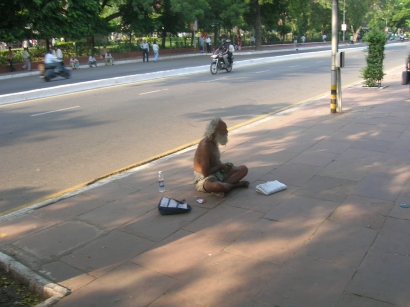
Well, this picture above was taken in Delhi, one of those that I took very quickly during the trip. It's a priest in the streets. The end count of pictures is 967 and they fit perfectly on a 700MB CD. I like to have taken pictures of the very common things inbetween the monumental pics, because they show outsiders very well what the region of the country that we visited is like. Notice the use of the word "REGION", because travelling 200km already takes you to a place that is noticeable different in motor-taxi's, clothes, food and population.

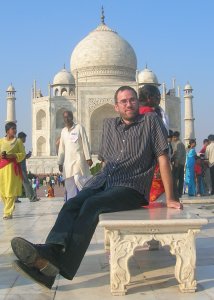
Here on the left is the portal to the Taj Mahal. You can notice the architecture that is abundant across India, the towers with round dome and in this case Mogul type archways.

Looking closer near the main archway, you see a rectangular white/black line. This is actually a poem in Arabic. The photo was taken from the middle of the garden inbetween the gate and the Taj.

Contrary to regular expectation, I'm not going to write "final comments" in this blog about India. It simply is unfit to capture a whole country as such with that much diversity into a single statement and since I have only started to touch the surface, it would not be justified. Also, as a software engineer, I did not visit Bangalore which is a must if I was to make any comments about the industry.

I can however write a couple of observations from the trip which are interesting
to ponder for Indians and foreigners:
  • The Indians are highly entrepreneurial. This entrepreneurial activity ranges from agriculture up/down to regular commerce, up to powerful investors and hotel chain owners and new innovative startups (like US tax handling in India, medical photo handling, etc)
  • There is a high demand boom for management people in the country, not just because of domestic interest but quite highly for providing links for export/import.
  • There are many research centres in India and other initiatives that aim at a particular thing to be resolved. Jaipur for example has a medical center where they treat only 2-3 illnesses, but the process for doing that has been so thought out and improved that they can handle hundreds if not thousands of cases per year.
  • I got the impression that identification of risk for Indians may be difficult.
  • Indians leave large ambiguous gaps in communication with others, especially when foreigners do not understand the particular balancing of the head that has a specific meaning. Not sure if this persists in software as well, but if so, I can understand this to create problems in requirements engineering.
  • I perceive the country at the moment as service-based and also the people as highly service-oriented, not so much production or manufacturing based. This means for example you will find very nice hotels, people willing to help you everywhere and earn a buck, but maybe not so many companies that are exceptionally strong in producing a product. However this is more based on intuition than academic or empirical research.
Well, we have bought a couple of new books in India actually, one of them from "Jeffrey Sachs". This person has helped to develop the economic development plan for countries and therefore describes from a personal point of view what decisions he took and how he helped Bolivia and Poland (recently started only).

The interesting part at the start of the book already is that he makes the point that there is no reason to get really concerned about world economic activity, where countries like China and India are gaining foothold in the world markets, but other countries are not.

One of the common assumptions that he challenges is that people see the increase of one country's economy as a threat or a necessary decrease in the economy of another. As if the world's resources and economy are fixed (but may be growing slightly) and these are to be divided between the countries determined by their efficiency and capability.

His assertion is that there is no such thing, only "growth" and that this growth brings along new opportunities altogether. Now, this is an interesting statement! Consider for example the market for i-pods. At the moment the market for this apparel is about 1 billion people over the world? But there are about 6 billion at the moment. That means that if the poor that at the moment cannot yet afford an iPod will never buy one (maybe steal it and the original owner buy a new one). However, if 2 billion more people get into this market, the market for iPods multiplies three-fold!

The other very important thing to consider here is a country's production and waste. Pollution, packaging and these types will go up significantly, as is the number of cars that will drive around. Will the world be up to that level of pollution produced? That is a difficult question.

Tuesday, October 31, 2006

Udaipur

Two days ago we went for a sightseeing tour of Udaipur. It is an interesting little town of 800,000 inhabitants, but I personally prefer the others I have visited. There are only a couple of interesting sites to visit, the main one being the City Palace, which has been the palace of the Maharaja and was built in 15-something. The palace has now been converted to a museum. Different generations of maharaja's have extended the palace and it is known as the second-largest palace in India, according to the guide.

Night view over Udaipur:


Udaipur has also some very expensive hotels (probably because it is known as one of the most romantic cities). We're staying more outside the city, which is still good and comfy.

Bottom view of temple stairs:


There are not many good restaurant, but one that I can definitely recommend is Ambrai, which is close to the waterfront with a view on the Lake Palace hotel. In the evening it is advisable to make reservations. The food is very good, the ambience is good and at night there are a couple of firework displays around 2030 or so.

Detail view of decoration outside temple wall:


The tour of the city also took us to a temple, another Hindu temple that is, which has a slightly different build than the others. I also took some detailed photographs of the artwork this time. The artwork on the side of the temple is based in layers. The elephant for example is for luck, the horse is for power. Above the horses is a long line of human figures. If you look closely, you will see that these figures are not repetitive, but are all different scenes.

Single snapshot of main entrance to palace:


The Internet access here is more abundant, but still not fast. Many of the shops have one or two PC's where you can access mail, but going to gmail or the blog is a pain to load. Also here in the hotel for example they say there is Internet, but it turns out to be a 333 Mhz machine in windows 98 with a 19,2000 bps connection. One of the shops said he had cable, but the effective speed over it was still not much more than a good-working dialup connection.

Scene at the main lake, near Lake Palace hotel:


There is also a lot of commerce in this town but not of the same quality as we saw in Jodhpur or Jaipur. So far, Jaipur was best for shopping.

We are about to go to the airport now to fly back to Mumbai. Probably I won't post anything until we're back in London for a couple of days. Then Paris for a night and half a day, then back to Recife. Yay! ;).

G>

Sunday, October 29, 2006

Jodhpur to Udaipur

The road from Jodhpur to Udaipur is across the mountains. It starts off with a smaller road through some ethnic villages at the base of the mountain. The resort where we stayed offered a so-called "village safari", which is basically a drive through the villages to get in touch with local village life (it is not sightseeing as it is said).


It is good to get off the bigger road for a while and see more of these villages. We went through numerous and saw mixed Hindu and Muslim together. In the picture here you see a young sheep-herder. He is part of one of the villages on the mountain-side.


The whole point of taking the inner roads is to get to the Raknapur Temple. This is a Hindu temple somewhere in the middle of the mountains and bushes. In the time it was built it must have stood right between the trees as well. As you can see in the picture, this temple has enormous delicate artwork on the sides. Inside, it is filled with pillars with artwork engravings and on each side of the temple a carved elephant.

The temple is not even-floored, it has numerous steps and different levels in the flooring. There are some dome-like ceiling structures with more artwork. On each side, there are large windows or sitting areas that look into the mountain side or across the mountain (but not far). The air in the temple is full of incense.


Going more up the mountain, I suddenly saw a very old watermill. The idea is that the water is used for irrigation and flows to another part somewhere after the water is lifted from the area with small bucket-like things a couple of feet higher into a trench. Cows were used to rotate the mill, accompanied by two workers.


Closeby some elders were watching along (what else can you do on a sunday afternoon at the top of a mountain?).

We're in Udaipur now, which has a lakeside. It is known as one of the most romantic cities of India, but I'm not yet personally convinced. In the middle of the lake is a hotel and restaurant, the Lake Palace, owned by the Taj Group. Tomorrow we are going around the city for sightseeing.

I'm staying in room 404 (and yes, for any IT-nerds out there, we actually FOUND the room).

Saturday, October 28, 2006

Jodhpur


Well, we are in Jodhpur now in a resort at the moment. This city is getting closer to Pakistan. For this reason there is quite an abundance of military training centers, medical centers and even military schools. Jodhpur is the blue city, which got its color due to the prominance of the Brahman caste.

To explain this further:

Most societies are divided in layers that have different social status. This division can be established in a number of ways (how many women you have, how many camels, job, etc.). In most western societies this division is done by wealth. Here in India, it is actually done by religion and has not much to do with power, nor wealth. This is an interesting point. The blue city is blue because the city that used to house so many people of the Brahman caste live here. They paint their houses blue. This caste consists of priests and is the highest layer in society. You can recognize people from every caste by their last name, which is an indication where they come from. I was told that even up to now, some people follow this distinction. I asked around and found out that the last name "Sharma" is associated with this caste, allegedly.

If you go one level below, you get to the warrior caste. The associated color is red. One of the most common names in this caste is "Singh". Certain maharaja families are also called Singh, like the family in Jodhpur. One level below is the caste of merchants, it is associated with the color yellow or white. The final level below there is the level of nomads, street sweepers and toilet cleaners. Its associated color is black and there is no city constructed with this color.
Speaking of the cities, you would then see: Jodhpur -> Blue, Jaipur -> Red / Pink, Udaipur -> White / Yellow.

The picture with this post is taken from the top of the Jodhpur fort. It shows the part of the city where the priests live. Unfortunately I had to take this picture against the sun, so it is not very clear.


Inside the fort you can still see the rooms intact with some of its inventory. This is an example of the room of mirrors. There is also a room that is now used for dancing, a room that was used by the parliament (in the time when the maharaja still ruled as a king, at the moment he has more like an exemplary role, like the king / queen in the UK / Holland), and finally the bedroom.


Well, Jodhpur is not very rich when it comes to tourist highlights, but it is a lot cleaner than many of the other cities you will find. The only other interesting highlight is the belltower in the middle where the market is located.


The lack of many tourist attractions may explain that you will not find pre-pared clothes, the silk or cotton is normally chosen and then the tailer does the clothes and can bring it to the hotel at night. As a final example, we asked to see some turbans and he wanted to show how turbans are put on the head. Unfortunately his winding skills were not that good, so it was a bit of a weird head-cake.

On The Road


Here I am showing only four of the pictures that I gathered on the road in India. We went by car (Toyota Innova) from Delhi to Agra, Jaipur, Jodhpur and will go to Udaipur tomorrow. It was explained to us today that the suffix "pur" means the city was established by Hindu's, whereas "bad" means the city was established by Muslims.

The first picture shows a farmer next to the road, who is driving somewhere on his cart pulled by his cow. The cow is far from the only means that is used to pull a cart. I see more camels and horses in this area. Most of the animals that are pulling the cart have some kind of ornament on the horns or nose.


As I noticed earlier, driving around in India is hell. I would be glad to get back to Brazil where driving is at least quite sane :). Humours aside, here is a picture I snapped that shows you the sight you will see driving on your side of the dual carriage way and how they turn on their headlights as if they are in their right. If you imagine the possibility of other ongoing traffic on your side, you can imagine the complexity if the truck drives on the fast lane in the opposite direction. So there is no way you can relax for a moment, then it's a cow, then it's a truck in the other direction, then it's the traffic on your side cutting you off, then it's a donkey, then it's a guy running across the road without looking...

The drivers here seem to only believe in the elements of "good luck" and "bad luck". It's a little bit strange how this works out. I see cars that are sometimes swirling across the road where obviously the driver is suffering from exhaustion or simply is too sleepy to carry on. Rather than stopping and throwing some water on their head, walking around, get back in the proper state of awakenedness, they simply carry on as if it's bad luck to fall asleep behind the wheel. Our driver also suffers from severe drowsiness after lunch. When he scratches his head, his eyelids start to fall down and we have to almost order him to stop, because he won't do it himself (pride? duty?).


Well, the other things you encounter of course are trucks, sometimes voluminously overloaded. This is an example of such a truck loaded with cotton. Some of them have the cotton sticking out on both sides, this one was rather badly loaded. :)

It is always possible that the truck breaks down. Here is an example of the numerous broken down trucks that you encounter along the way. Every 200km I guess there are about three at least. Some trucks have simply flat tires, others have broken axles, others have fallen over in a ditch due to sleepy drivers (or drunk, as my driver told me. It seems that some people do actually drink along the way in some very dark bars and then get back on the road).


So, this is only a four-picture sample of what you encounter along the road. The scenery of course also changes. I have seen woods, lines of birch-trees (I guess birch, not sure), desert, prickly bushes, sand and mountains. Sometimes the land is flat, sometimes you can see distant mountains.

Friday, October 27, 2006

Jaipur Sightseeing

Well, one of the things to see is the Amber Fort in Jaipur. I have pictures all over the place.


If you compare the artwork to other pictures I have taken, there are minute differences in the kind of drawings, the colors and materials used. The archways that you find are also different. If an archway has an inverted V without embellishments, it is basically of old Moghul architecture, the Muslim kings also called Sjahs.

But if you see archways that have embellishments in a more circular inverted V, these are old Hindu buildings. The kings of Hindu's were called Maharaja's. There were quite a number of fights already that many years ago between Sjah's and Maharaja's.


Jaipur is a very interesting city. Some of the photo's may show a more desert-like scenery. Ethnically, Jaipur shows a lot more about older India than the other places. If you like shopping, I would recommend doing that here, because the experience itself is better and the kinds of things you can purchase here are also nicer than in other areas I have seen (if you are after beautiful / ethnic stuff that is ). I can't imagine wearing a turban or the traditional clothes at other times than Carnival in Brazil, so I left things where they were. Nevertheless, lots of shiny things in the clothes here, very fine silk, interesting colors and beautifully made. Some of it probably comes from factories, but some deal is hand-made.


Jaipur also has an observatory like Delhi. The most precise time-measuring equipment there can measure time up to 2 seconds, that is taking into account a certain correction.


We're slowly getting to the end of the trip as well. Jodhpur is still waiting for us (the blue city) and afterwards Udaipur. We'll do some sightseeing there too and will then return to Mumbai, London, Paris and Recife.